
Choose Etsy for marketplace discovery; choose Shopify for greater control over your storefront and brand. Etsy can be a practical way to start selling eligible handmade, vintage, craft, and digital products. Shopify gives you a dedicated online store, but you need a plan to bring shoppers to it. The right choice depends less on features than on how customers will find you.
Start with your route to the first sale
Etsy is a marketplace where shoppers already search for products. Your listings can appear alongside those of established sellers, and a familiar buying environment may reassure new customers. That access does not guarantee visibility. Photography, search relevance, pricing, reviews, and competition all affect how a listing performs.
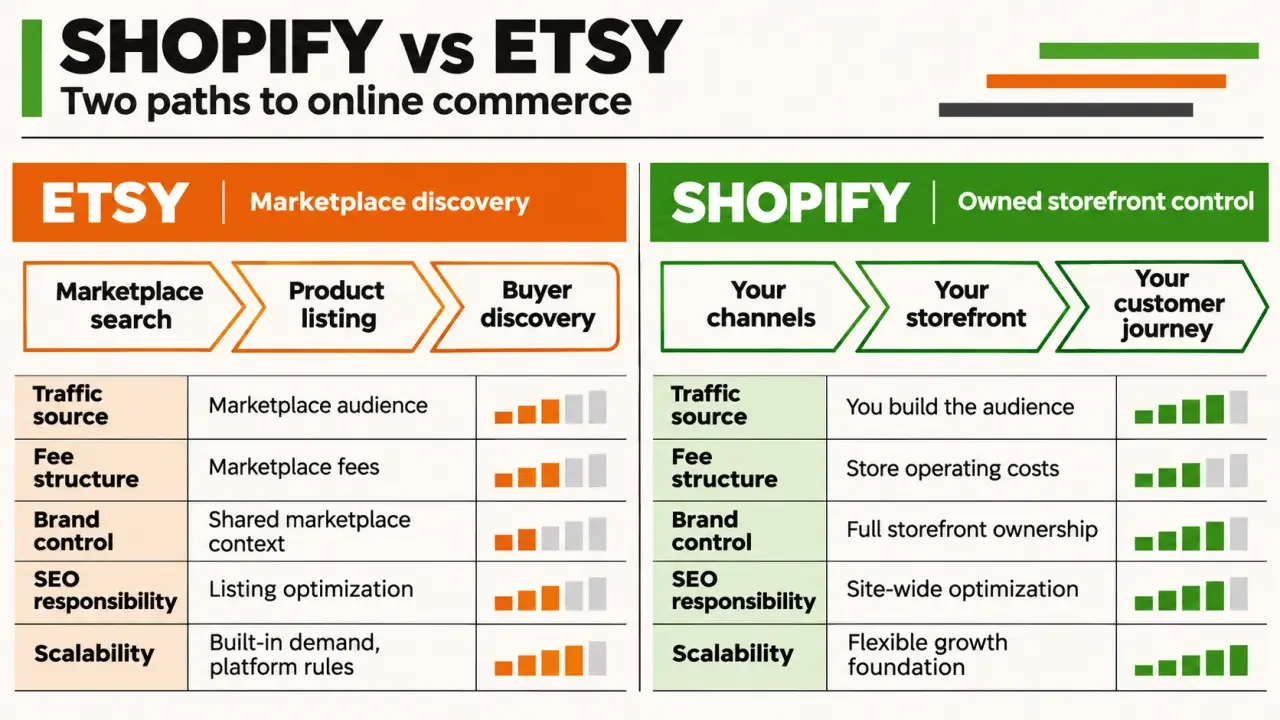
Shopify provides the infrastructure for your own online store, not a ready-made audience. You need a credible way to attract visitors, such as an existing social following, search traffic, email subscribers, partnerships, or paid advertising.
| Decision factor | Etsy | Shopify |
|---|---|---|
| Traffic source | Marketplace search and discovery | Primarily your own marketing |
| Cost structure | Listing, transaction, payment, and applicable advertising fees | Subscription, payment costs, and optional extras |
| Brand control | Shop within Etsy’s layout | Dedicated domain and customizable storefront |
| SEO focus | Visibility within marketplace search | Website structure, content, and external search visibility |
| Growth path | Expand marketplace sales | Build a broader, multichannel business |
If you have no audience, Etsy may be the more practical starting point. If followers already ask where to buy your products, Shopify can make sense from the beginning.
Compare profit per order, not just platform fees
Neither platform is automatically cheaper. Etsy’s selling charges add up as orders come in. Shopify adds a recurring subscription, before payment processing, apps, or marketing. Exact costs depend on your location, payment setup, plan, and applicable advertising rules, so check current terms before budgeting.
Compare both platforms using the same monthly order volume and average order value. Include:
- Etsy: listing and renewal charges, transaction fees, payment processing, and applicable Etsy Ads or Offsite Ads charges.
- Shopify: subscription, payment processing, any applicable third-party transaction fees, domain, paid apps, and advertising.
- Both: product costs, packaging, shipping subsidies, returns, and your operating time.
Etsy’s Offsite Ads can charge on attributed sales rather than individual clicks, but those charges still affect your margin. Check participation requirements and attribution terms instead of treating those orders as free discovery.
Use this calculation: sales revenue minus product, fulfillment, platform, payment, and acquisition costs equals contribution before overhead. A lower selling fee may not help if you spend more to acquire each customer. A subscription can become easier to justify when consistent sales spread that fixed cost across more orders.
Match setup effort and brand control to your business
Etsy involves fewer storefront decisions. You create your shop, prepare listings, configure shipping, and work within its existing structure. This suits a solo maker who would rather improve product photography than plan website navigation.
Shopify’s no-code themes make store building more accessible, but you still need to organize collections, connect a domain, configure payments, test shipping, and check the mobile buying experience. Apps can add functionality, but they may bring extra costs, setup work, and dependencies.
The additional work gives you more control over presentation, content, and the customer journey. Shopify also offers SEO tools, analytics, and options for international and in-person selling. Availability and customization can depend on your plan, location, and integrations.
Consider what customers remember after a purchase: your business, or simply buying something on Etsy. Brand recognition can matter when products encourage repeat purchases. Consistent packaging, a memorable domain, and useful post-purchase communication can help build it. Contact customers for marketing only with appropriate consent. A marketplace purchase is not permission to add someone to a mailing list.
Choose your starting point and a sensible expansion trigger
Etsy suits sellers testing demand for products allowed under its current policies. Handmade goods, vintage items, craft supplies, and eligible digital products are natural categories to assess. Check the requirements before investing in stock. Etsy is not a general-purpose marketplace for every retail model.
Shopify suits businesses with a repeatable way to attract customers, a need for stronger branding, or operations that extend beyond marketplace selling. But the possibility of scaling is not a reason to build an elaborate store before confirming demand.
You can also sell on both platforms. Keep Etsy as a discovery channel while developing Shopify for traffic you acquire independently. Follow Etsy’s rules on communications and transactions; do not use listings to divert marketplace purchases.
- Identify a proven product range and a credible traffic source for the standalone store.
- Launch a focused Shopify catalog instead of rebuilding everything at once.
- Use consistent product identifiers and test inventory synchronization through a suitable integration, such as Shuttle.
- After an import, check variants, images, shipping settings, and stock counts. Do not assume reviews or every data field will transfer.
The strongest reason to expand is not frustration with fees alone. It is evidence that customers seek out your brand and that you can serve them profitably outside the marketplace. Until then, improving a viable Etsy shop may be more valuable than managing a second storefront.
Questions to answer before choosing a platform
Can you start on Etsy and move later?
Yes, but do not assume that marketplace demand, reviews or customer relationships transfer perfectly. Keep organised product data, original images and a customer-retention plan that respects each platform’s rules.
Is Shopify useful without an existing audience?
It can be, but the store does not create demand by itself. Budget time and money for content, search, partnerships, email or paid acquisition. An owned store gives more control; it also makes traffic generation your responsibility.
When does using both make sense?
A hybrid approach can use Etsy for discovery and Shopify for a broader branded experience. It works best when inventory, pricing and fulfilment are synchronised and the operational overhead does not erase the benefit.
What should be compared beyond headline fees?
Model listing costs, transaction charges, payment processing, apps, advertising, returns and staff time. Then compare contribution margin by channel instead of focusing on one fee in isolation.
Which option is less risky?
The answer depends on the main risk. Etsy reduces the burden of finding early marketplace traffic; Shopify reduces dependence on one marketplace and offers greater control. Many sellers manage risk by testing demand before expanding.