
Choose idea management software when collecting suggestions is no longer the problem, but deciding what happens next is. The right platform gives promising ideas an owner, a clear evaluation process, and a visible route to implementation. For a small team with occasional submissions, a shared form and task board may still be enough.
Start your buying decision with the workflow, not a feature count. A polished submission portal adds little value if ideas sit in an unreviewed queue. The platform should help people assess proposals, assign next steps, and keep contributors informed.
Decide how much process you actually need
Idea management software helps organizations collect, discuss, assess, and advance suggestions. These may concern internal processes, customer experience, new products, or business models. The goal is to turn scattered contributions into decisions and work that people can follow.
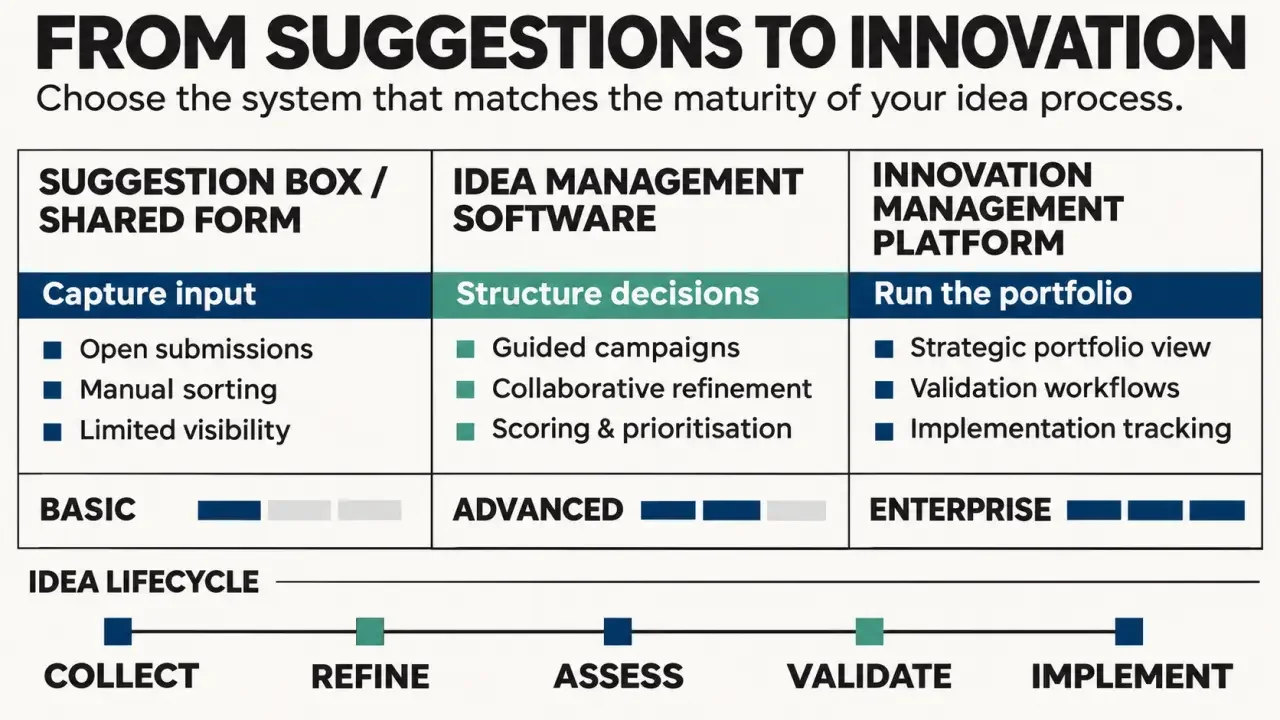
Innovation management tools generally cover a broader remit. They may connect idea assessment with experiments, investment decisions, portfolio oversight, and value realization. The categories overlap, so evaluate demonstrated capabilities rather than relying on a vendor’s label.
| Tool category | Primary job | Best fit |
|---|---|---|
| Suggestion box or shared form | Capture submissions for manual review | Low submission volume and a single decision-maker |
| Idea management software | Structure feedback, assessment, ownership, and progression | Recurring programs involving several teams |
| Broader innovation management platform | Connect ideas with validation, investment, and portfolio oversight | Programs managing multiple innovation initiatives |
For creators and small businesses, administrative overhead matters. If one person can review each suggestion and assign the work, dedicated software may add more process than value. Cross-department reviews, repeated follow-ups, and unclear ownership are stronger reasons to upgrade.
Consider the maturity of your process, too. A team that is still learning how to collect useful suggestions may benefit more from a simple intake process than a complex stage-gate system. As the number of contributors and reviewers grows, structured assessment and a shared view of progress become more useful.
Test the handoffs, not just the submission form
Ask vendors to demonstrate one realistic idea from arrival to delivery. Use your own example, such as simplifying customer onboarding, rather than accepting a rehearsed tour of unrelated features. Watch how the idea moves between people and stages, and note where a manual follow-up is still required.
- Collect: Capture the problem, intended beneficiary, proposed change, and supporting evidence. Support ongoing intake or deadline-based challenges as needed.
- Refine: Use feedback threads to clarify assumptions, identify duplicates, and bring in relevant colleagues.
- Assess: Compare ideas against explicit criteria, such as business relevance, effort, risk, and expected benefit.
- Validate: Assign an experiment, prototype, MVP, or financial risk assessment before committing substantial resources.
- Implement: Name the delivery owner, track progress, and record the outcome.
The critical handoff is the move from approval to execution. An idea can be marked “accepted” yet remain motionless because nobody has taken responsibility for delivery. Require that transition to create a named owner, a next action, and a review date. That process makes stalled work easier to spot than another popularity score.
Different ideas need different routes. A minor process improvement should not require the same stage-gate reviews as a new business model. Check whether administrators can adjust stages, criteria, permissions, and conditional triggers without coding or routine vendor intervention. Ask how the platform handles tasks, deadlines, and notifications at each stage, too.
A useful workflow makes status clear to both reviewers and contributors. It should show what has been assessed, what is waiting for evidence, and what needs a decision. If the system supports several paths, confirm that each path remains understandable rather than creating a maze of exceptions.
Make participation useful, not just visible
Collaboration features should improve decisions, not merely generate activity. Voting can reveal interest, but popularity is not proof of feasibility or customer demand. Ask contributors to explain their votes, and let reviewers document why a less popular proposal deserves further investigation.
Transparency means explaining decisions and next steps. Contributors should be able to see whether an idea needs clarification, is awaiting assessment, has entered validation, or has been declined. A short explanation for rejecting an idea is more useful than indefinite silence. Regular updates can also help prevent contributors from assuming their suggestions have disappeared.
During evaluation, check follow notifications, version history, and permissions. Participants need relevant updates without constant alerts, while reviewers may need restricted access to commercially sensitive details. Test what an ordinary contributor sees, not only the administrator dashboard. Confirm that people can follow an idea without being added to every discussion or receiving unnecessary notifications.
Inspect the submission experience as well. A long mandatory form can discourage early contributions; an empty text box can produce vague suggestions. Start with essential fields and request more evidence when an idea advances. For a time-limited challenge, check whether the platform can provide a clear prompt and deadline. For ongoing intake, make sure contributors can submit ideas without waiting for a campaign to open.
Build a shortlist around evidence and total effort
InnovationCast and HYPE Innovation are relevant vendors to investigate. InnovationCast emphasizes configurable workflows and lifecycle coverage, while HYPE positions its idea management offering around structured collaboration and participation. Treat these as starting points for demonstrations, not a verified ranking or a guarantee of suitability.
Compare dedicated platforms and simpler alternatives against the same requirements. A task-management system may handle a modest internal pipeline; a broader innovation platform may be more appropriate when experiments and investment oversight are central. A consistent demonstration scenario makes it easier to compare how well each option supports your actual process.
- Configuration: Ask your future administrator to modify a workflow during the demo. Check whether changes require coding or vendor assistance.
- Handoffs: Verify integrations with your delivery tools, including what information synchronizes and in which direction. Confirm how teams can track assigned tasks and deadlines.
- Governance: Review permissions, export options, retention controls, and security documentation.
- Support: Clarify whether onboarding includes process guidance, configuration assistance, and administrator training. Ask who helps when a workflow needs to change.
- Cost: Request an itemized quote covering licenses, implementation, integrations, support, and any usage limits.
Before purchasing, pilot one business challenge with a named sponsor and reviewer. Track review time, unresolved ownership, contributor updates, and progression into validation or implementation. Note where people still need to move information offline or chase decisions manually. Choose the platform that makes the next decision easier, not the one that collects the largest pile of ideas.